
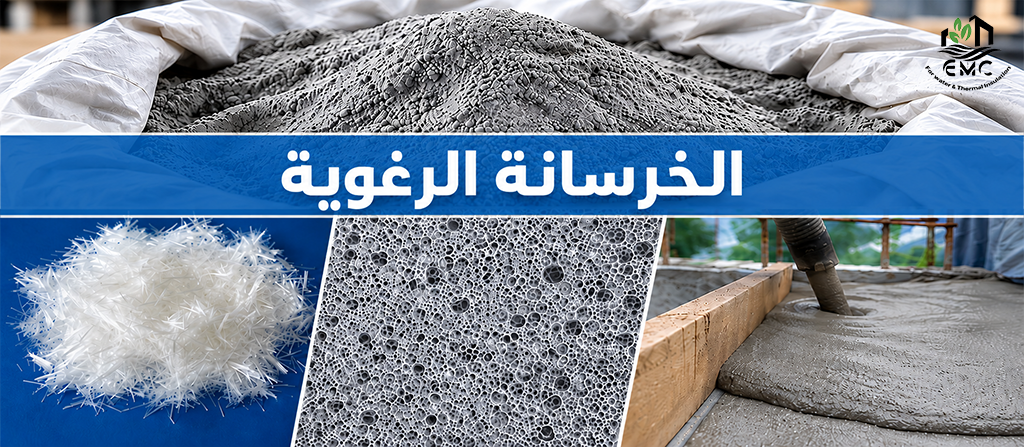
Foamed Concrete
What is Foamed Concrete?
Foamed Concrete, also known as Cellular Lightweight Concrete (CLC), is a type of lightweight concrete produced by introducing stable foam into a mixture of cement, water, and sand. This process creates millions of closed air cells throughout the concrete, resulting in a lightweight material with excellent workability, pumpability, thermal insulation, and reduced structural loads.
The density of foamed concrete typically ranges from 400 to 1,850 kg/m³, depending on the project requirements. Its density can be tailored for a wide range of applications, including lightweight filling, floor leveling, thermal insulation, and the production of lightweight concrete elements.
Foamed concrete is considered one of the most efficient engineering solutions for projects requiring reduced dead loads, fast installation, and easy application. It can be pumped directly into place without mechanical compaction, making it an ideal choice for various structural and architectural applications.
Why is Foamed Concrete One of the Best Solutions for Lightweight Filling and Leveling?
Foamed concrete combines lightweight performance, ease of installation, thermal insulation, and dimensional stability in a single system. Its cellular structure significantly reduces the self-weight of the concrete compared to conventional concrete, helping minimize loads on roofs, floors, foundations, and structural elements.
It also offers excellent pumpability over long distances and into confined spaces. Thanks to its high flowability, it easily surrounds pipes and fills voids without requiring vibration or mechanical compaction, reducing installation time while providing a uniform and stable layer.
How Does Foamed Concrete Work?
Foamed concrete is produced by mixing cement, sand, and water with pre-generated foam created by a Foam Generator using a specialized foaming agent. The fine air bubbles are evenly distributed throughout the mixture, forming a homogeneous cellular structure.
These closed air cells reduce the concrete's density while improving its thermal insulation properties and maintaining excellent workability and pumpability. This makes foamed concrete ideal for lightweight filling, roof leveling, void filling, slope formation, and thermal insulation applications.
Components of Foamed Concrete
1. Binder
Cement is the primary binding material used in foamed concrete. Ordinary Portland Cement is the most commonly used binder, while supplementary cementitious materials may be added when required to improve durability, performance, or reduce shrinkage.
2. Foam Agent
The foam agent is responsible for creating the fine air bubbles that give foamed concrete its lightweight structure and insulating properties. Depending on project specifications, either synthetic or protein-based foaming agents may be used.
3. Water & Plasticizer
Clean water is used while maintaining the appropriate water-to-cement ratio to achieve optimum workability without affecting foam stability. Plasticizers may also be added to improve flowability and reduce water demand while maintaining concrete quality.
4. Fibers
Polypropylene fibers, alkali-resistant glass fibers, or other suitable reinforcement fibers may be incorporated to improve crack resistance, reduce shrinkage, and enhance the mechanical performance of foamed concrete.
Advantages of Foamed Concrete
-
Lightweight compared to conventional concrete.
-
Available in various densities for different applications.
-
Reduces dead loads on structures.
-
Provides excellent thermal insulation.
-
Easily pumpable over long distances and heights.
-
Requires no mechanical compaction.
-
Excellent flowability and workability.
-
Completely fills voids and cavities.
-
Speeds up construction and installation.
-
Ideal for lightweight filling and roof leveling.
-
Reduces the use of conventional concrete in many applications.
-
Good fire resistance.
-
Improves sound insulation compared to traditional concrete.
-
Density can be customized according to project requirements.
Applications
Foamed concrete is widely used in civil engineering and construction projects, including:
-
Roof slope formation.
-
Roof and floor leveling.
-
Covering service pipes and utilities.
-
Lightweight roof filling.
-
Filling voids and cavities.
-
Underfloor heating backfill.
-
Roads, bridges, and tunnels.
-
Soil stabilization and grouting.
-
Renovation and rehabilitation of existing buildings.
-
Landscaping and exterior works.
-
Sports courts and recreational facilities.
-
Lightweight concrete blocks and panels.
-
Airport arrestor blocks and barriers.
-
Filling wall cavities and industrial voids.
Installation Process
1. Site Preparation
The work area is cleaned thoroughly by removing dust, loose materials, and contaminants. Any necessary repairs or preparation work is completed before installation begins.
2. Mix Preparation
The foamed concrete mixture is prepared using cement, sand, water, and pre-generated foam. The foam is carefully introduced into the mix to achieve the specified density according to project requirements.
3. Pumping and Placement
The foamed concrete is pumped using specialized equipment directly to the application area. Its excellent flowability allows it to fill voids and confined spaces without the need for vibration or mechanical compaction.
4. Leveling
After placement, the surface is leveled to the required elevations and slopes while ensuring a smooth and uniform finish.
5. Curing
The foamed concrete is allowed to cure under suitable site conditions. Proper curing procedures are followed when required to achieve the desired strength and long-term durability.
Technical Specifications
| Item | Specification |
|---|---|
| System Type | Foamed Concrete |
| Installation Method | Mixing & Pumping |
| Density | 400–1,850 kg/m³ |
| Binder | Ordinary Portland Cement |
| Foam Agent | Synthetic or Protein-Based Foam Agent |
| Water Content | As per Mix Design |
| Workability | High |
| Placement Method | Pumped Application |
| Compaction | No Mechanical Compaction Required |
| Thermal Insulation | Excellent Compared to Conventional Concrete |
| Applications | Lightweight Filling, Leveling, Thermal Insulation, Void Filling |
| Suitable Areas | Roofs, Floors, Roads, Bridges, Buildings |
Frequently Asked Questions
What is Foamed Concrete?
Foamed concrete is a lightweight concrete containing millions of closed air cells created by adding stable foam to a cementitious mixture. It is widely used for lightweight filling, leveling, thermal insulation, and reducing structural loads.
What is the difference between Foamed Concrete and Conventional Concrete?
Foamed concrete has a much lower density and weight than conventional concrete. It offers better thermal insulation, excellent pumpability, and is mainly used for lightweight filling and leveling applications rather than primary structural elements.
Is Foamed Concrete Suitable for Roof Applications?
Yes. Foamed concrete is widely used for roof slope formation, roof leveling, pipe covering, and lightweight filling while minimizing additional loads on the building.
Can the Density of Foamed Concrete Be Controlled?
Yes. The density can be accurately adjusted according to the project requirements, making it suitable for a wide variety of engineering and construction applications.
Does Foamed Concrete Require Mechanical Compaction?
No. Thanks to its excellent flowability and self-leveling characteristics, foamed concrete fills voids and reaches confined spaces without the need for vibration or mechanical compaction.
Why Choose EMC?
At EMC, we utilize advanced foamed concrete production and pumping systems together with premium-quality materials and experienced engineering teams to deliver reliable, high-performance solutions. Our mix designs are tailored to each project's requirements, ensuring the required density, quality, and long-term performance while meeting the highest industry standards for efficiency, durability, and sustainability.