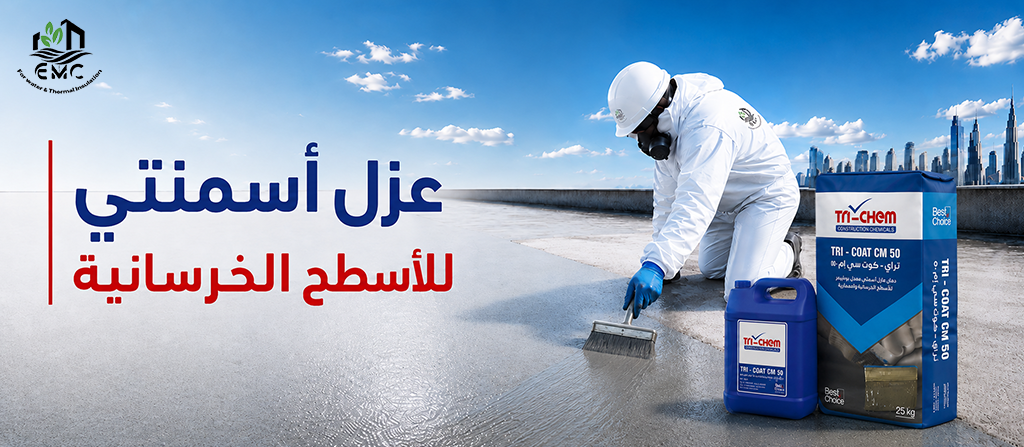
Concrete Roof Waterproofing with Cementitious Waterproofing System
What is the Cementitious Waterproofing System?
The Cementitious Waterproofing System is a waterproofing solution used to protect concrete surfaces from water leakage, moisture, and humidity. It depends on applying a polymer-modified, two-component cementitious coating, such as TRI-SEAL 307.
The material is applied in two perpendicular coats to form a strong, cohesive waterproofing layer that prevents water penetration into the concrete. After that, an acrylic protective coating such as TRI-ACRYPROOF is applied to enhance the system’s resistance to weather conditions and extend its service life.
What Makes the Cementitious Waterproofing System Effective?
Cementitious waterproofing provides strong adhesion to concrete and cement-based surfaces. It also helps seal fine pores and reduce water penetration, making it a practical and effective solution for roofs and wet areas.
The system can be used for both positive and negative waterproofing, depending on the site condition. It is also suitable for areas exposed to continuous water or moisture when applied correctly according to technical specifications.
How Does Cementitious Waterproofing Work?
Cementitious waterproofing forms a cohesive protective layer over the concrete surface, helping reduce water absorption and protecting the surface from moisture damage caused by leakage.
The success of the system depends on proper surface preparation, crack and joint treatment, forming coving at floor-to-wall connections, and applying the waterproofing material in two perpendicular coats to ensure better coverage of the surface, corners, and detailed areas.
Features of the Cementitious Waterproofing System
-
Provides effective protection against water leakage and moisture.
-
A flexible cementitious coating modified with polymers and made of two components.
-
Offers strong adhesion to concrete and cement-based surfaces.
-
Suitable for positive and negative waterproofing according to site conditions.
-
Ideal for roofs, water tanks, basements, bathrooms, and kitchens.
-
Suitable for structures exposed to seawater and weather conditions.
-
Weak areas can be reinforced with fiber or fleece when needed.
-
Covered with an acrylic protective coating to increase resistance and extend the system’s service life.
Applications
The Cementitious Waterproofing System is used for waterproofing concrete roofs, bathrooms, kitchens, water tanks, basements, underground structures, water basins, and areas exposed to moisture or water leakage.
It is also used in structures that require a strong and cohesive waterproofing system to protect concrete from water effects and weather conditions.
When is Cementitious Waterproofing the Best Solution?
Cementitious waterproofing is the best solution when a strong waterproofing system is required for concrete surfaces or areas exposed to continuous water and moisture.
It is recommended for areas that need a cohesive and easy-to-apply waterproofing layer, especially water tanks, bathrooms, kitchens, basements, and concrete roofs, with the option to apply an acrylic protective coating to improve system performance.
Cementitious Waterproofing Application Steps
1. Surface Preparation and Cleaning
The surface is cleaned thoroughly from dust, oils, grease, casting residues, and any weak or loose parts to ensure strong adhesion of the waterproofing layers.
2. Crack and Joint Treatment
Cracks, openings, and joints are treated using suitable materials. Coving is also formed at floor-to-wall connections to prevent water leakage from connection points.
3. Primer Application
A bonding agent such as SBR is applied to improve adhesion and prepare the surface for the cementitious waterproofing layers.
4. Cementitious Waterproofing Application
The cementitious waterproofing material, such as TRI-SEAL 307, is applied in two perpendicular coats, with a suitable drying time between coats to ensure uniform and effective coverage.
5. Acrylic Protective Coating Application
After the waterproofing layers are fully dry, an acrylic protective coating such as TRI-ACRYPROOF is applied to protect the waterproofing layer from sunlight, rain, and weather conditions.
6. Testing and Handover
After complete drying, the waterproofing system is tested to ensure its efficiency and confirm that there are no leaks. The surface is then handed over after final quality inspection.
Acrylic Protective Coating
The acrylic protective coating is an important step after applying the cementitious waterproofing system. It helps protect the waterproofing layers from direct exposure to sunlight, rain, moisture, and weather conditions.
It also helps maintain the efficiency of the waterproofing system for longer periods and reduces the impact of external factors on the main waterproofing layer.
Technical Specifications
| Item | Specification |
|---|---|
| System Type | Cementitious Waterproofing System |
| Material Composition | Two-component polymer-modified cementitious coating |
| Waterproofing Material | TRI-SEAL 307 |
| Application Method | Two perpendicular coats |
| Primer | SBR |
| Protective Coating | TRI-ACRYPROOF Acrylic Coating |
| Protective Coating Rate | Around 600 g/m² |
| Suitable Surfaces | Concrete and cement-based surfaces |
| Application | Waterproofing for roofs and wet areas |
| Special Resistance | Suitable for seawater exposure and weather conditions |
| Required Treatments | Cracks, joints, and coving when needed |
| Standard Specifications | ASTM C321 / C307 / C580 |
Frequently Asked Questions
Is cementitious waterproofing suitable for all types of surfaces?
Cementitious waterproofing is mainly used on concrete and cement-based surfaces. It performs best when the surface is properly cleaned and cracks and joints are treated before application.
Can cementitious waterproofing be used in bathrooms and water tanks?
Yes, it can be used in bathrooms, kitchens, water tanks, basements, and water basins when applied according to the correct specifications.
Why is cementitious waterproofing applied in two coats?
It is applied in two perpendicular coats to ensure better surface coverage, seal fine pores, improve waterproofing efficiency, and reduce the chances of water leakage.
Is cementitious waterproofing suitable for positive and negative waterproofing?
Yes, it can be used for both positive and negative waterproofing depending on the site condition and the type of water exposure.
Why is the acrylic protective coating important?
The acrylic protective coating helps protect the cementitious waterproofing layer from sunlight, rain, and moisture. It also helps extend the system’s service life and maintain its efficiency.
Why Choose EMC?
EMC has strong experience in applying waterproofing and thermal insulation systems, with full attention to every stage of the work, starting from surface inspection and preparation, through crack and joint treatment, to applying the waterproofing layers and protective coating.
We ensure that every step is carried out according to industry standards and the supervising engineer’s instructions, using high-quality materials and a specialized technical team to deliver a complete waterproofing system that protects concrete surfaces from water leakage and moisture for long periods.