
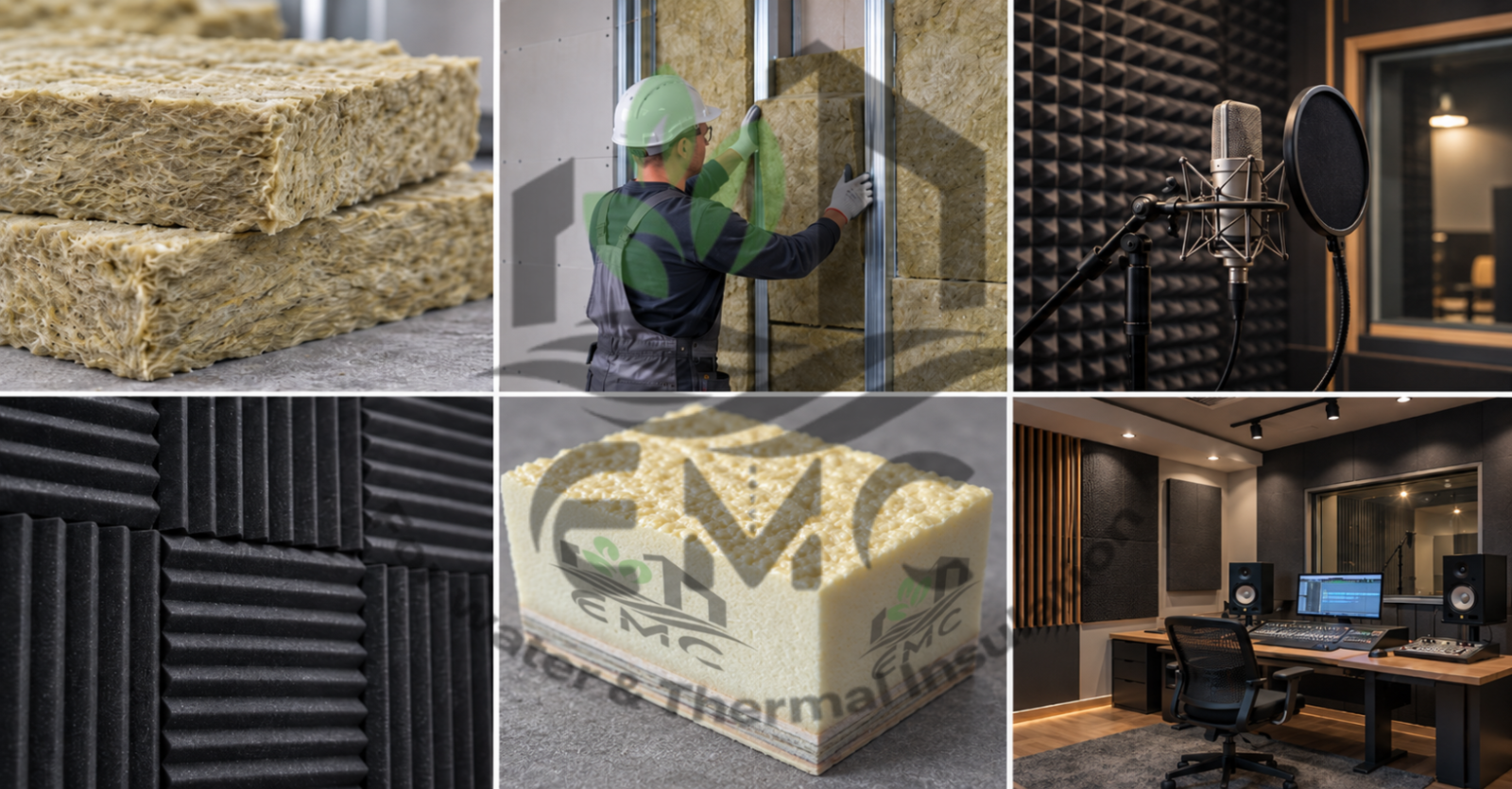
The Complete Guide to Reducing Noise Transmission and Improving Acoustic Comfort in Buildings and Facilities
Introduction
Noise has become one of the most common factors affecting comfort in residential, commercial, administrative, and industrial buildings, especially with the increasing number of sound sources generated by traffic, equipment, machinery, and everyday activities.
The problem is not limited to high sound levels. Noise can also travel between rooms and floors, or from outside a building to the interior, through airborne sound, impact, or structural vibration.
For this reason, sound insulation is an important building system used to reduce noise transmission and improve the indoor acoustic environment.
The effectiveness of any sound insulation system depends on understanding the source of the noise and the way it travels, followed by selecting the appropriate materials and wall, ceiling, or floor configuration according to the required level of performance.
Common materials used in sound insulation and sound absorption applications include rock wool and selected types of polyurethane foam.
In this guide, we explain the concept of sound insulation, how it works, the main materials and applications, and the key factors to consider when choosing the most suitable system for a project.
What Is Sound Insulation?
Sound insulation is the use of materials and systems designed to reduce the transmission of noise from one space to another.
It can be used to limit:
-
Airborne sound.
-
Impact noise.
-
Vibrations transmitted through building elements.
-
External noise entering the building.
-
Sound transmission between rooms and floors.
The appropriate system depends on the source of the sound, its frequency, intensity, and transmission path.
How Does Sound Insulation Work?
Sound travels in the form of waves that carry energy from the sound source through the surrounding environment.
When these waves reach walls, ceilings, or floors, part of the sound energy may:
-
Be reflected.
-
Be absorbed.
-
Pass through the element to the other side.
Hard and smooth surfaces such as concrete, glass, and metal tend to reflect a larger proportion of sound, which can increase reverberation inside a space.
Porous and fibrous materials, on the other hand, can absorb part of the sound energy and reduce sound reflections.
Effective acoustic design therefore focuses on both reducing sound transmission and controlling sound reflection within the space.
Sound Insulation vs. Sound Absorption
These two concepts are often confused, although they serve different purposes.
Sound Insulation
Sound insulation is intended to reduce sound transmission from one space to another, such as reducing noise from a meeting room reaching adjacent offices.
Sound Absorption
Sound absorption is intended to reduce sound reflections and reverberation within the same room.
Therefore, installing a sound-absorbing material does not necessarily mean that sound transmission to an adjacent room will be completely prevented.
The first step is to determine whether the project requires:
-
Reduced sound transmission.
-
Improved acoustic quality within the room.
-
Or a combination of both.
How Does Noise Travel Through Buildings?
Sound transmission within buildings can generally be divided into three main categories:
Airborne Sound
Examples include:
-
Speech.
-
Television.
-
Music.
-
Traffic noise.
-
Noise generated by certain equipment.
Impact Noise
Examples include:
-
Footsteps.
-
Dropped objects.
-
Furniture movement.
Impact noise may travel through floors, ceilings, and structural elements.
Structure-Borne Vibration
Certain machines and equipment can transmit vibrations into floors, walls, and structural systems.
This type of noise is particularly important in some industrial facilities.
Identifying the sound transmission path is therefore one of the most important steps before selecting an insulation system.
Why Is Sound Insulation Important?
Sound insulation is not limited to studios and recording facilities. It is increasingly important in many types of buildings.
Its main benefits include:
Reducing Noise Transmission
A properly designed system helps reduce sound transmission between rooms and from outside the building.
Increasing Privacy
Acoustic privacy is particularly important in:
-
Offices.
-
Meeting rooms.
-
Clinics.
-
Hotels.
-
Residential units.
Improving Indoor Comfort
Reducing unwanted noise and reverberation creates a more comfortable environment for living and working.
Improving Acoustic Quality
In studios, theaters, halls, and similar spaces, sound absorption helps reduce reverberation and improve sound clarity.
Controlling Industrial Noise
Suitable acoustic systems can help reduce the effects of noise and vibration generated by machinery and equipment.
Where Is Sound Insulation Used?
Sound insulation systems are used in many applications, including:
-
Houses and residential apartments.
-
Bedrooms.
-
Offices and meeting rooms.
-
Hotels.
-
Hospitals.
-
Schools and universities.
-
Cinemas and theaters.
-
Event halls.
-
Recording and production studios.
-
Broadcasting rooms.
-
Factories.
-
Equipment rooms.
-
Commercial and industrial facilities.
There is no single system suitable for every application, so the nature of the sound and the requirements of each project must be evaluated before selecting the solution.
Types and Materials of Sound Insulation
Common materials used in sound insulation and absorption applications include:
-
Rock wool.
-
Mineral wool.
-
Open-cell polyurethane foam.
-
Closed-cell polyurethane foam.
First: Rock Wool
Rock wool is a fibrous insulation material typically manufactured from volcanic rocks such as basalt, which are melted and formed into fine fibers.
Its fibrous structure helps absorb part of the sound energy, making it suitable for use within many wall, ceiling, and partition systems.
Rock wool also provides thermal insulation in addition to acoustic performance.
How Does Rock Wool Work?
When sound waves enter the fibrous structure of rock wool, air particles move between the fibers.
This movement creates friction and causes part of the sound energy to dissipate, thereby reducing reflected or transmitted sound.
Rock wool is commonly used in:
-
Interior walls.
-
Partitions.
-
Ceilings.
-
Certain floor systems.
-
Cavities between finishing layers.
Advantages of Rock Wool
-
Good sound absorption performance.
-
Suitable for wall and ceiling systems.
-
Provides thermal insulation as well as acoustic performance.
-
Offers good fire resistance depending on the product and its classification.
-
Available in different densities and thicknesses.
-
Suitable for many residential, commercial, and industrial applications.
Limitations of Rock Wool
-
Requires proper installation as part of a suitable system to achieve the required performance.
-
Acoustic performance depends on the complete wall or ceiling assembly, not only on the insulation material.
-
It should be protected from continuous water and moisture exposure according to system requirements.
-
Thickness, density, and installation method have a direct effect on performance.
Acoustic Performance of Rock Wool
The performance of rock wool varies according to its density, thickness, and the construction system in which it is installed.
In certain laboratory-tested assemblies containing rock wool with a thickness of approximately 4 cm, a value of around:
Rw = 45 dB
has been reported.
However, this value is related to the specific tested assembly and should not be considered a fixed rating for all rock wool products or applications.
Second: Polyurethane Foam
Polyurethane foam is primarily used as a thermal insulation material, although certain types may also contribute to sound absorption and noise reduction depending on cell structure, density, and thickness.
It is important to distinguish between sound absorption and sound transmission reduction.
Applying foam to a wall does not necessarily mean that all sound transmission will be blocked, but it may form part of an integrated acoustic treatment system.
Open-Cell Polyurethane Foam
Open-cell foam has a porous structure that allows air to move through the material.
This structure helps absorb part of the sound energy and is therefore commonly used for:
-
Reducing reverberation.
-
Improving indoor acoustics.
-
Absorbing certain mid- and high-frequency sounds.
Advantages of Open-Cell Foam
-
Porous structure that supports sound absorption.
-
Suitable for improving indoor acoustic conditions.
-
Can be applied within cavities and irregular details.
-
Relatively lightweight.
Limitations
-
Should not be considered a complete sound barrier on its own.
-
Performance depends on thickness, density, and sound frequency.
-
Properties vary from one product to another.
-
Moisture resistance is generally lower than that of closed-cell foam.
Closed-Cell Polyurethane Foam
Closed-cell foam has a denser and more tightly connected structure.
This gives it high thermal insulation performance and lower water absorption compared with open-cell foam.
It may also contribute to controlling certain forms of sound transmission as part of a complete system.
Advantages of Closed-Cell Foam
-
High thermal insulation efficiency.
-
Higher density.
-
Low water absorption.
-
Can contribute to reducing certain types of noise.
-
Suitable for a wide range of buildings and surfaces.
Is Polyurethane Foam a Complete Soundproofing Material?
That depends on the objective of the application.
If the goal is to completely prevent sound transmission between two rooms, polyurethane foam should not be relied upon as a standalone solution.
However, if the objective is to absorb part of the sound energy, reduce reverberation, and improve acoustic comfort, certain polyurethane foam systems can provide useful performance when the appropriate type, density, and thickness are selected.
Sound Absorption Coefficient
The sound absorption coefficient is used to evaluate how effectively a material absorbs sound.
The coefficient typically ranges from:
0 to 1
The higher the value, the greater the proportion of sound energy absorbed rather than reflected.
However, material performance varies according to sound frequency, so a single number cannot fully represent performance under all conditions.
What Is NRC?
NRC – Noise Reduction Coefficient is a simplified indicator used to describe the sound absorption capability of materials across a range of frequencies.
In certain tests on samples of pure polyurethane foam, an approximate value of:
NRC = 0.30
has been reported.
Some modified samples containing fibrous materials have shown improved sound absorption performance.
These values remain specific to the tested materials and conditions and should not be considered universal values for all polyurethane foam products.
Sound Insulation vs. Thermal Insulation
Thermal Insulation
Thermal insulation is designed to reduce heat transfer between the inside and outside of a building and improve energy efficiency.
Polyurethane foam is widely recognized as a high-performance thermal insulation material.
Sound Insulation
Sound insulation is designed to reduce noise transmission or control sound reflection within a space.
Some thermal insulation materials may also provide acoustic benefits, but this does not mean that every thermal insulation product is a complete sound insulation system.
Comparison of Common Sound Insulation Materials
| Material | Sound Absorption | Thermal Insulation | Moisture Resistance | Common Applications |
|---|---|---|---|---|
| Rock Wool | High in suitable systems | Good | Requires protection depending on the system | Walls, ceilings, and partitions |
| Mineral Wool | Good to high depending on type | Good | Depends on the product | Walls and ceilings |
| Open-Cell Polyurethane Foam | Good | Good | Relatively low | Cavities and acoustic treatment |
| Closed-Cell Polyurethane Foam | Contributes within the overall system | Very high | Relatively high | Roofs, walls, and various facilities |
Note: The performance of a sound insulation system cannot be evaluated based on the material alone. Final performance depends on thickness, density, assembly configuration, sound frequency, and installation quality.
How to Choose the Best Sound Insulation System
Selecting the correct system should begin with understanding the acoustic problem itself.
The main factors to consider include:
1. Sound Source
The source of noise should first be identified, such as:
-
Speech.
-
Traffic.
-
Music.
-
Machines and equipment.
-
Impact.
-
Vibration.
2. Sound Transmission Path
Does the sound travel through the air, walls, floors, or the structural frame?
3. Sound Frequency
Different materials respond differently to low-, medium-, and high-frequency sound.
4. Element to Be Insulated
The system may be required for:
-
Walls.
-
Ceilings.
-
Floors.
-
Internal partitions.
-
An entire room.
5. Required Acoustic Performance
A bedroom does not require the same level of sound insulation as a recording studio or industrial equipment room.
6. Thermal Insulation Requirements
In certain projects, a system can be selected to meet both acoustic and thermal insulation requirements.
Common Mistakes That Reduce Sound Insulation Performance
Relying on a Single Material
Effective sound insulation usually depends on an integrated system rather than one individual material.
Confusing Insulation with Absorption
Reducing reverberation inside a room does not necessarily mean preventing sound transmission to another room.
Leaving Gaps and Openings
Sound may travel through weak points and gaps within walls and construction details.
Selecting the Wrong Material
Materials react differently depending on the type and frequency of the sound.
Ignoring Vibration
The actual source of the problem may be vibration transmitted through the structural system rather than airborne sound.
Incorrect Thickness or Density
Thickness and density are important factors affecting the acoustic performance of many insulation materials.
How Is Sound Insulation Performance Evaluated?
Several indicators are used to evaluate acoustic performance.
Sound Absorption Coefficient
Measures the proportion of sound energy absorbed by the material.
NRC
Used to evaluate sound absorption performance across a range of frequencies.
Rw
Weighted Sound Reduction Index – Rw is used to evaluate the ability of building elements such as walls and partitions to reduce airborne sound transmission.
In general, a higher value indicates a greater ability of the tested assembly to reduce sound transmission.
Sound Insulation in New and Existing Buildings
New Buildings
Sound insulation is generally easier to integrate during the construction stage because insulation materials can be incorporated directly into walls, ceilings, and floors.
Existing Buildings
Acoustic performance can also be improved in existing buildings, but the following should first be identified:
-
The noise source.
-
The transmission path.
-
The building element requiring treatment.
-
The available space for additional insulation layers.
Some situations may require treatment of more than one building element at the same time.
Why Choose EMC for Insulation Works?
Successful insulation depends on proper technical assessment, correct system selection, and quality of application.
At EMC, each project is evaluated according to the nature of the facility and its operating requirements, beginning with site inspection and assessment of surrounding conditions and continuing through selection of the appropriate insulation system.
The selected solution is based on several factors, including:
-
Type of facility.
-
Type of structural element.
-
Noise source.
-
Sound transmission path.
-
Thermal insulation requirements.
-
Operating conditions.
-
Required level of performance.
Frequently Asked Questions About Sound Insulation
What Is the Best Type of Sound Insulation?
There is no single material suitable for every project.
The correct choice depends on the noise source, sound transmission path, building element, and required acoustic performance.
What Is the Difference Between Sound Insulation and Sound Absorption?
Sound insulation aims to reduce sound transmission from one space to another, while sound absorption aims to reduce reverberation and sound reflection within the same space.
Is Rock Wool a Good Sound Insulation Material?
Yes. Rock wool is widely used within walls, ceilings, and partitions to help absorb sound and improve the acoustic performance of the complete assembly.
Does Polyurethane Foam Work as Sound Insulation?
Certain types of polyurethane foam can help absorb sound and reduce noise, but foam alone should not be considered a complete barrier against all sound transmission.
Which Is Better for Sound: Open-Cell or Closed-Cell Foam?
Open-cell foam is generally more suitable for sound absorption and improving indoor acoustics.
Closed-cell foam has a higher density and provides greater thermal insulation and moisture resistance, while also contributing to noise control as part of a complete system.
Can Sound Insulation Be Installed in an Existing Building?
Yes. However, the source of the noise and its transmission path should first be identified before selecting the appropriate system.
Conclusion
Sound insulation is not simply a matter of installing a material on a wall. It is a complete system that begins with understanding the noise source and how the sound travels.
Sound may be transmitted through the air, through impact, through vibration, or through structural elements. For this reason, the problem must be properly assessed before choosing the solution.
Materials such as rock wool and polyurethane foam are used in many acoustic applications, but the performance of each material varies according to its structure, density, thickness, and method of installation.
It is also important to distinguish between sound absorption within a space and reducing sound transmission from one space to another.
The best system is therefore not necessarily the densest or most expensive material, but the solution that matches the type of building, source of noise, transmission path, and required performance level.
Do You Need Technical Consultation for Your Project?
If you are looking for a suitable sound or thermal insulation solution for your project, the EMC team can assess the nature of the facility, noise source, and operating requirements to determine the most technically appropriate system and implement the insulation works in accordance with project requirements and engineering specifications.