
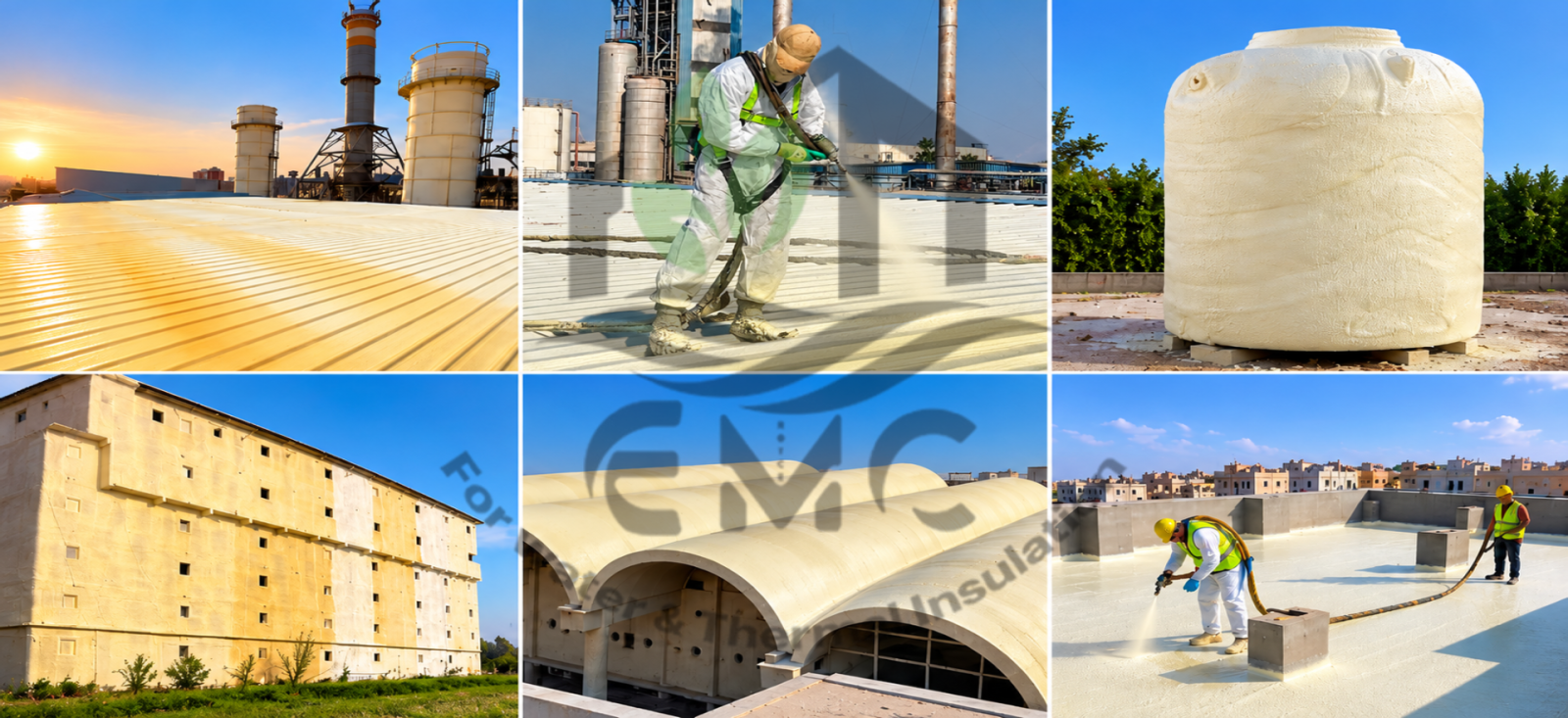
Benefits of Polyurethane Foam Insulation: Technical Properties, Thermal Efficiency, and Waterproofing Performance
Polyurethane Foam Insulation is an advanced insulation technology used in residential, commercial, and industrial buildings. It is widely recognized for its ability to reduce heat transfer, create a continuous insulation layer, and help control air leakage and moisture movement.
Closed-Cell Polyurethane Foam features a rigid cellular structure that combines excellent thermal insulation performance with mechanical strength, making it suitable for concrete roofs, metal roofing systems, factories, warehouses, and cold storage facilities.
The overall effectiveness of the insulation system depends on the material's properties, insulation thickness and density, application quality, and the protective coatings used.
What Is Polyurethane Foam and How Does It Work?
Polyurethane foam is a polymeric material produced through a chemical reaction between polyol compounds and isocyanates, together with chemical additives and blowing agents that create its cellular structure.
When applied using specialized spray equipment, the material expands across the substrate and subsequently hardens, forming a cellular insulation layer.
In closed-cell polyurethane foam, most of the foam cells are sealed, helping reduce heat transfer and water absorption while providing rigidity and mechanical resistance suitable for various applications.
1. High Thermal Insulation Efficiency
One of the most important benefits of polyurethane foam insulation is its high resistance to heat transfer.
Thermal performance is evaluated using thermal conductivity, represented by the symbol λ, which indicates how readily heat passes through a material.
The lower the thermal conductivity, the greater the material's resistance to heat transfer at the same thickness.
Technical data for certain rigid closed-cell polyurethane foam systems indicate that the initial thermal conductivity may be below 0.026 W/(m·K), demonstrating the high thermal efficiency of these specific formulations.
It is important to distinguish between initial thermal conductivity and long-term thermal performance. The thermal properties of some foam formulations may gradually change as gases diffuse into and out of the foam cells over time. This process is known as thermal aging.
Therefore, insulation design should consider thermal performance values appropriate to the intended service life rather than relying exclusively on initial measurements.
The thermal resistance of an insulation material is calculated using:
R = d / λ
Where:
-
R: Thermal resistance.
-
d: Insulation thickness in meters.
-
λ: Thermal conductivity.
These properties help reduce heat transfer through roofs and walls, thereby lowering thermal loads within buildings.
2. Seamless and Continuous Insulation Layer
Polyurethane foam can be applied directly by spraying, allowing the formation of a continuous, seamless insulation layer.
During application, the material expands to cover surfaces, corners, and irregular areas without requiring multiple insulation boards or numerous joints.
This continuity helps minimize gaps that could allow air leakage or reduce thermal performance.
However, a continuous insulation layer does not necessarily eliminate all thermal bridges created by structural or metallic components, which must be considered during system design.
3. Reduced Air Leakage
Uncontrolled air leakage can significantly affect a building's thermal performance, as heat is transferred through air movement across cracks, joints, and openings.
Closed-cell polyurethane foam can function as an air barrier when installed at the appropriate thickness, provided that the insulation layer remains continuous and all penetrations and joints are properly sealed.
This characteristic helps reduce unwanted airflow, maintain more stable indoor temperatures, and support the efficiency of heating, ventilation, and air-conditioning systems.
4. Low Water Absorption and Moisture Resistance
The closed-cell structure of polyurethane foam generally provides lower water absorption compared with open-cell foam materials.
This cellular structure also helps limit water vapor transmission through the insulation layer, making it suitable for applications requiring moisture control.
However, it is essential to distinguish between a material's resistance to water absorption and the waterproofing performance of a complete roofing system.
Low water absorption does not automatically mean that polyurethane foam alone provides a complete waterproofing solution under all conditions.
Exposed roofing applications therefore require a properly designed system that addresses joints, penetrations, and drainage areas, together with suitable protective coatings and finishing layers.
5. Compressive Strength and Mechanical Rigidity
Rigid polyurethane foam possesses mechanical properties that allow it to resist compressive stresses.
Technical specifications for certain closed-cell polyurethane foam systems indicate that compressive strength may exceed 400 kPa, depending on the testing method and conditions.
Compressive strength describes the material's ability to withstand compressive stress at a specified deformation level or according to the applicable testing criterion.
This property makes rigid polyurethane foam suitable for selected industrial and construction applications.
However, compressive strength measured during short-term testing does not necessarily represent the material's capacity to withstand sustained loads at the same stress level.
Long-term design must consider mechanical creep and deformation over time.
Polyurethane foam insulation should not be considered a substitute for load-bearing structural elements.
6. Dimensional Stability Under Temperature and Humidity Changes
External surfaces are exposed to continuous variations in temperature and humidity, which can cause building and insulation materials to expand or contract.
Dimensional stability is an important property used to assess a material's ability to maintain its dimensions under specified conditions.
Technical data for certain rigid polyurethane foam formulations indicate that linear dimensional changes may remain below 1% under the stated testing conditions.
This characteristic helps minimize undesirable dimensional changes, although actual performance depends on the foam formulation, application conditions, and environmental exposure.
7. Strong Adhesion to Different Substrates
Polyurethane foam can adhere directly to various substrates, including concrete, metal, and certain types of wood, provided that material compatibility is confirmed and the surface is properly prepared.
Direct spray application allows the insulation layer to follow the substrate's geometry and cover irregular details.
Good adhesion also helps reduce the possibility of voids forming between the insulation and the underlying surface.
Adhesion quality depends on surface cleanliness, moisture content, substrate temperature, application conditions, and the specifications of the insulation material.
8. Relatively Lightweight with High Thermal Performance
Polyurethane foam has a cellular structure that allows it to provide high thermal resistance at relatively limited thicknesses.
Technical specifications for certain rigid closed-cell polyurethane foam systems indicate an applied density of approximately 55–65 kg/m³, although other formulations are available with different densities.
This characteristic helps limit the additional weight imposed by the insulation layer, particularly in metal roofing and industrial building applications.
Density and thickness must be selected according to thermal and mechanical requirements, as increasing foam density does not necessarily improve thermal insulation performance.
9. Reduced Risk of Condensation
Condensation occurs when the temperature of a surface reaches or falls below the dew point, causing water vapor in the surrounding air to turn into liquid water.
Thermal insulation helps regulate surface temperatures and reduce the likelihood of conditions that promote condensation.
Closed-cell polyurethane foam can also help limit air and water vapor movement when incorporated into a properly designed insulation system.
These properties are particularly important in cold storage facilities, industrial buildings, and air-conditioned environments where significant temperature differences exist between indoor and outdoor conditions.
Effective condensation control requires careful consideration of temperature, humidity, insulation layer arrangement, and vapor control requirements.
10. Adaptability to Complex Surfaces
Spray polyurethane foam technology allows insulation to be applied to surfaces with different geometries, including corrugated metal roofs, corners, and areas surrounding pipes and industrial equipment.
This flexibility makes it possible to reach locations that may be difficult to insulate using conventional rigid boards.
It also reduces the need to cut and assemble multiple insulation components, helping achieve greater layer continuity.
Application quality depends on maintaining consistent insulation thickness and uniform material distribution, especially around edges, corners, and penetrations.
11. Fast Application and Coverage of Large Areas
Spray polyurethane foam systems are characterized by rapid chemical reactions and the formation of a foam structure within a relatively short period.
Technical data for certain formulations indicate a cream time of 2–4 seconds and a gel time of 4–6 seconds at a test temperature of 25°C.
These values describe reaction characteristics and should not be interpreted as the time required for complete chemical curing or safe return to service.
Spray application also facilitates the continuous insulation of large areas, although actual installation rates depend on project size, required thickness, substrate condition, and weather conditions.
12. Improved Energy Efficiency
Effective thermal insulation reduces heat transfer through the building envelope, thereby lowering the heating or cooling loads required to maintain the desired indoor temperature.
Under steady-state conditions, the rate of heat transfer can be expressed as:
Q = U × A × ΔT
Where:
-
Q: Heat transfer rate, measured in watts.
-
U: Overall heat transfer coefficient, measured in W/(m²·K).
-
A: Surface area in square meters.
-
ΔT: Temperature difference in kelvin.
Increasing the total thermal resistance of a roof or wall reduces its overall heat transfer coefficient (U-value), resulting in lower heat transfer under otherwise identical conditions.
This can help reduce energy consumption associated with air-conditioning and refrigeration systems.
However, actual energy savings depend on building characteristics, climate, insulation thickness, and equipment efficiency.
Applications of Polyurethane Foam in Buildings and Industrial Facilities
The thermal and mechanical properties of polyurethane foam make it suitable for a wide range of engineering applications, including:
-
Concrete roofs: Reducing heat transfer through roof structures as part of an appropriate insulation and protection system.
-
Metal roofs and industrial sheds: Improving thermal performance and reducing heat gain inside buildings.
-
Factories and warehouses: Supporting temperature control and reducing thermal loads.
-
Cold storage and freezing facilities: Limiting heat transfer between indoor and outdoor environments while addressing water vapor control requirements.
-
Walls and ceilings: Improving the thermal efficiency of building envelopes.
-
Agricultural buildings and storage facilities: Helping maintain more controlled thermal conditions.
The appropriate foam type, density, thickness, and protective coating system should be selected according to the technical requirements of each application.
Key Factors for Ensuring Effective Polyurethane Foam Insulation
The performance of polyurethane foam insulation depends not only on the material's properties but also on proper engineering design and installation quality.
Important considerations include selecting the appropriate foam formulation, specifying the required density and thickness, preparing the substrate correctly, and controlling mixing ratios and application temperatures.
It is also essential to ensure consistent insulation thickness, properly treat joints and penetrations, and apply protective coatings suitable for environmental exposure and ultraviolet radiation.
Fire safety requirements are another essential aspect of insulation system design.
Reaction-to-fire performance varies depending on the foam formulation, protective layers, and complete building assembly.
Polyurethane foam should not be considered fire-resistant simply because it is a thermal insulation material.
Conclusion
Closed-cell polyurethane foam insulation is an effective engineering solution for thermal insulation applications, combining high resistance to heat transfer, the ability to form a continuous insulation layer, relatively low water absorption, strong adhesion to suitable substrates, mechanical rigidity, and application flexibility.
These properties help improve the thermal performance of buildings and industrial facilities, reduce thermal loads, and support energy efficiency.
Achieving the required performance ultimately depends on selecting the appropriate material, implementing a suitable engineering design, ensuring high-quality installation, and using protective coatings compatible with the intended operating conditions.